What Are the Latest Robotics Trends Shaping Smart Manufacturing?
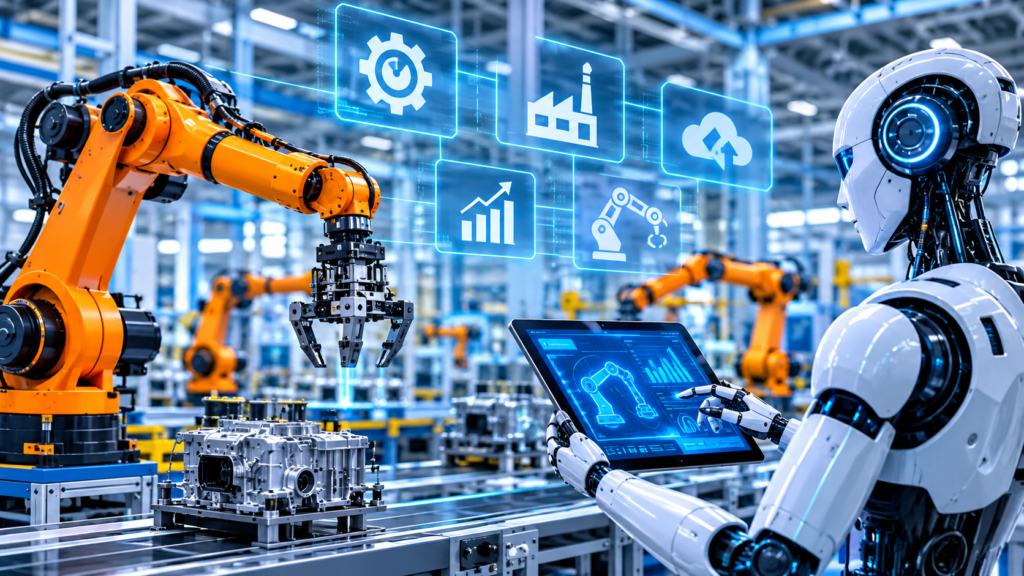
The world of manufacturing is undergoing a dramatic shift with robotics and automation playing an increasingly vital role in the process. Manufacturers are increasingly turning to the latest in robotic technology to achieve such objectives as increasing productivity, decreasing operational costs, ensuring product quality and meeting the increasing demands of customers. These technologies are revolutionizing the way factories work, from automated assembly lines to intelligent industrial robots.
Smart manufacturing integrates robotics, artificial intelligence, sensors, machine learning and connected systems to optimize manufacturing processes. Such technologies can be used to reduce repetitive tasks, keep an eye on equipment performance and make quicker operational decisions for businesses.
The digital transformation of industries has increasingly made robotics an investment for manufacturers who are looking to grow and become more competitive in the long term.
Understanding Robotics in Smart Manufacturing
The term robotics in smart manufacturing is used to describe the application of programmable machines and automated systems to speed, accuracy and consistency to tasks involved in manufacturing. These robots are capable of welding, assembly, packaging, material transport, inspection and handling of products.
In contrast to conventional automatic robots, modern industrial robots are much more sophisticated. They can collaborate with sensors, cameras, AI and connected software to adapt to evolving production needs.
Technologies are employed in smart factories to link various manufacturing processes. This enhances the machine coordination, production team coordination, and management system coordination, and also reduces the unnecessary manual intervention.
AI-Powered Robotics Technology is Reshaping Production
AI technologies enable industrial robots to become more intelligent and adaptable. In the past, traditional robots would only execute commands that were programmed, but with AI, robots are able to analyze data, detect patterns, and adapt to some changes in their working environment.
AI-powered robotics can be used in manufacturing to aid quality control, predictive maintenance, automated sorting, and production optimization. Robots can use machine vision systems to locate objects, detect defects and carry out tasks more precisely than ever.
AI-powered robotics can provide manufacturers with the following benefits:
- More precise assembly and production.
- Quick detection of product defects.
- More efficient management of complicated manufacturing processes.
- Reduced dependence on repetitive manual activities.
- Increased productivity of production factors.
These features enable manufacturers to boost their operational efficiency and ensure quality in their production.
The use of Collaborative Robots is enhancing workplace efficiency.
Collaborative robots—or cobots—are robots built to work together with human workers in appropriate manufacturing settings. Cobots have the potential to be designed with safety features that allow for closer human-robot interaction with no required separation zones.
Small and medium-sized manufacturing companies can benefit from cobots as they can help with repetitive tasks without the need to automate all production processes.
Typical uses include machine tending, component assembly, packaging, screw fastening and material handling.
Human problem-solving abilities and robotic precision can be used together to offer more flexible production processes for manufacturers. Employees devote attention to work in which judgment, supervision, and technical skills play a role, and robots perform repetitive work.
Machine Vision Is Enhancing Quality Control
Quality of the product is one of the most significant in manufacturing. Any defect, no matter how minor, can result in customer complaints, product returns, wasted material, and loss of money.
Robotic machine vision systems are camera, sensor, and image-processing based devices that are used to check the product at various stages of manufacturing. These systems can detect surface defects, wrong dimensions, missing parts and other quality issues.
Automated inspection has a number of advantages:
- Regular product check-up throughout production runs.
- Quick identification of manufacturing errors.
- Decreased human mistake in repetitive inspections.
- Improved documentation of quality results.
- Improved production standards support.
Combining machine vision to industrial robotics allows for automated inspection and sorting tasks, with improved consistency for manufacturers.
Predictive Maintenance is Saving Equipment Downtime
Unexpected equipment failures can cause interruptions to production and lead to additional operating costs. Predictive maintenance involves sensors, connectivity and analytics that allow for the tracking of machine conditions and the potential for issues to be identified prior to significant breakdowns occurring.
A robotic manufacturing system can provide valuable operational information such as vibration, temperature, movement and equipment performance. Maintenance managers can utilize these data to look for irregularities and schedule maintenance services appropriately.
Predictive maintenance assist manufacturers in:
- Minimizing out-of-schedule machine breakdowns.
- Improve equipment reliability.
- Working more efficiently to maintain plans.
- Increase the life cycle of machines.
- Minimize production interruptions.
This approach will facilitate continuous manufacturing and help businesses to control maintenance expenses.
Autonomous Mobile Robots Are Improving Material Handling
Transporting raw materials, parts and products within manufacturing operations may be time consuming and labor intensive. AMRs are aiding manufacturers in warehouse and internal transport.
These robots have sensors, cameras and navigation systems that allow them to navigate materials in specific zones. They can move materials from storage areas, manufacturing lines and package areas.
Many AMRs can be programmed to change their path depending on the environment in which they are operating.Many AMRs are not fixed-path vehicles, meaning that they can alter their path as they go depending on their surroundings.
Their applications include:
- Transporting raw materials to production areas.
- Transportation of completed products to storage areas.
- Assisting in the warehouse picking process.
- Supplying parts from one workstation to another.
- Minimising unnecessary employee movement.
AMRs can help factories to become more organized and efficient by facilitating the movement of materials.
Digital Twins are Aiding in Smarter Manufacturing Decisions
Digital twin technology is a virtual model of a physical machine, production line or manufacturing facility. It applies realtime information and simulation tools to the benefit of manufacturers to gain insight into the performance of equipment and production systems.
Combined with robotics, digital twins can be used to investigate production processes, look for issues and test improvements without changing the real system.
Digital twins can be used by manufacturers to simulate production layouts, monitor the performance of robots, and gain insights into the impact of changes on the entire production process.
This technology can help minimize potential equipment upgrade risks and aid in future production planning.
The Flexibility of Manufacturing is being Enhanced by Robotics
Today’s customers want top quality products, quicker turnaround time and more product options. Manufacturers will thus need to make the necessary changes in the manufacturing process without causing any unnecessary delays or expenses.
Flexible manufacturing can be supported by advanced robotics as the ability to shift between tasks, products and production configurations.
The use of programmable robots, modular production equipment, and intelligent control systems simplifies the ability to modify manufacturing processes if customers’ needs shift.
This flexibility is especially useful in the automotive industry, electronics, consumer goods and industrial equipment manufacturing sectors.
Challenges of Adopting Robotics in Manufacturing
While there are numerous benefits of robotics, it’s important to plan carefully when implementing these technologies. Investments in robotic equipment, software integration, employee training and maintaining automated systems can be costly.
As well, manufacturers should think about cyber security, system compatibility, work site safety, and technical support prior to implementing advanced automation.
Important considerations include:
- Assessing the start-up costs and ongoing expense.
- Understanding how to use and service robotic systems.
- Making sure it fits in with current production equipment.
- Setting up suitable safety protocols.
- Securing the internet-connected manufacturing systems.
- Planning regular maintenance and technical support.
A slow-release approach could enable companies to cope with these issues while enhancing their manufacturing operations.
The Future of Robotics in Smart Manufacturing
Smart automation, connected machines and sophisticated robotic systems will become a critical component for manufacturing in the future. The emergence of AI, machine vision, collaborative robotics, and autonomous transport is likely to provide for more flexible production environments.
Both human and robotic solutions will be explored by manufacturers to further combine the two. Future automation strategies will concentrate on productivity, work place safety, quality improvement, and flexibility as opposed to just replacing manual activities.
Companies can create a better base for sustainable industrial development by investing in the right technologies and training their employees.
Conclusion
Robotics is playing an important role in shaping the future of smart manufacturing. AI systems, collaborative robots, machine vision, predictive maintenance, autonomous mobile robots, and digital twins are aiding manufacturers to enhance efficiency and product quality.
While robotics investment and planning is needed, the long-term benefits may make this an important component of contemporary production. Additionally, manufacturers can optimize operations, adapt to evolving customer needs, and stay competitive in the technologically advanced manufacturing sector by selecting the right automation solutions and training their workforce to leverage these technologies effectively.